





“Even though you’re fed up, you got to keep ya head up!” – Tupac
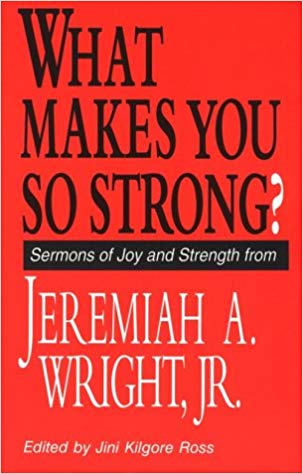
When reading the book, What Makes You So Strong?: Sermons of Joy and Strength, I was blessed to come across one of Rev. Dr. Jeremiah Wright’s, Pastor Emeritus of Trinity United Church of Christ in Chicago, most famous sermons “the Audacity to Hope.”
In this sermon, Dr. Wright speaks about what he describes as the difficulties of living in a messed up world. The difficulty of living in a world steeped with homelessness and food insecurity. The difficulty of living in a world steeped in racism, sexism, homophobia, and xenophobia. The difficulty of living in a nation established on the practices of genocide, slavery, and economic exploitation. The difficulty of living in a world governed by the power of the dollar rather than the principles of love, mercy, and compassion.
Likewise, his sermon helps us grapple with the more personal difficulties of loneliness and abandonment. The difficulties of a living in a family that withholds its love. The pains of betrayal at the hands of close friends and significant others. The difficulties of maintaining your mental stability when you are unable to escape the depressing and demoralizing effects of despair and dehumanization.
In his sermon, Dr. Wright describes these pains as the experience of living in a “quiet hell.” A quiet hell where, in his words, “the reality of the pains you are living in are too deep for your tongue to tell.” Yet, to overcome this quiet hell, Dr. Wright emphasizes the importance of the “audacity to hope,” and the need for us to remain bold, fearless, and courageous even when faced with seemingly hopeless situations.
Moreover, Dr. Wright reminds us that the audacity to hope does not occur merely when everything in our lives happen to be going good. Rather, the audacity to hope is when at times our lives feel to be unraveling at the seams, we have the nerve to continue believing in the power of God’s deliverance and saving grace. The audacity to hope is our willingness to remain bold in our beliefs, our trust in the power of God’s goodness and justice, and to trust in God even when we are surrounded by untrustworthy people.
The audacity to hope is when in the grip of constant catastrophe, confusion, and calamity we have the courage to do as the Psalmist states,
“To lift our souls to God, and to put our trust in the Lord; who will not let us suffer humiliation, nor let our adversaries triumph over us” (25:1).
The audacity to hope is when we find ourselves wrestling with despair, we have the gall and the guts to
“. . . bless the Lord at all times: whose praise shall continually be in my mouth. My soul shall make her boast in the Lord: the humble shall hear thereof, and be glad” (Psalm 34:1-3).
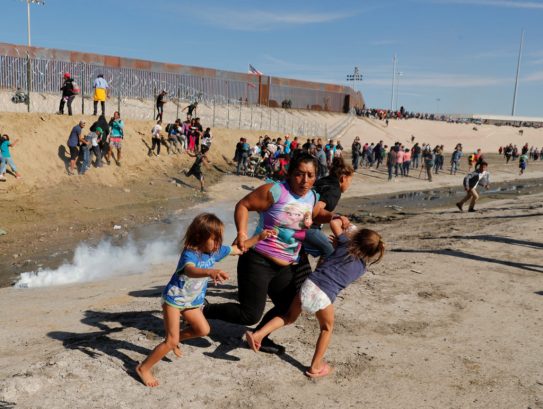
A migrant family, part of a caravan of thousands traveling from Central America en route to the United States, run away from tear gas in front of the border wall between the U.S and Mexico in Tijuana, Mexico November 25, 2018. REUTERS/Kim Kyung-Hoon
The audacity to hope is when our circumstances continue to go from bad to worse – when our health is deteriorating, when we have more bills than we have money to pay them, when our loved ones are testing our last supplies of patience, when our life at home can’t seem to get stable; yet, we continue to proclaim:
“The Lord is my Shepherd; I shall not want. He makes me to lie down in green pastures; He leads me beside the still waters. He restores my soul . . .”
The audacity to hope is
“Yea, though I walk through the valley of the shadow of death, I will fear no evil; for You are with me; Your rod and Your staff, they comfort me. You prepare a table before me in the presence of my enemies; You anoint my head with oil . . . Surely, goodness and mercy shall follow me all the days of my life; and I will dwell in the house of the Lord forever” (Psalm 23).
The audacity to hope is to do as Jesus taught His disciples with five loaves of bread and two fish, and we “pick up the fragments that remain, so that nothing is lost” (John 6:12). We pick up the fragments of our strength, the fragments of our faith, the fragments of our patience, the fragments of our broken hearts, so that nothing is lost – so that we are not lost, so that our world is not lost, so that our faith is not lost, so that our hope is not lost!
The audacity to hope is what Raphael Warnock, pastor of Ebenezer Baptist Church in Atlanta described as the act of “making music in a messed-up world.” The act of singing songs of freedom when the world is rife with injustice and tipping into chaos. The act of lifting up praise and worship to God even when God is silent and our connection to God feels distant.
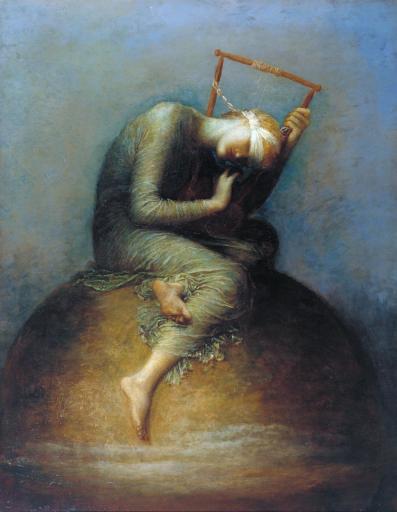
In a painting by an artist named George Frederic Watts, we see what it looks like to make music in a messed up world as his painting depicts the image of a tattered woman sitting on the top of a desolate earth as she continues playing music on a harp with broken strings. Both this painting and the woman are called Hope, and Dr. Wright describes this painting as “a study in contradictions, because the title of the painting and what is depicted on the canvas of the painting seem to be in direct opposition to each other.”
Ironically, even though the painting is titled Hope and the woman is named Hope, Hope appears to be hopeless and disheartened while sitting on top of the world and appearing as a victim and survivor of misery.
Sitting on top of the world – our world – we can see that Hope has been affected by the humanitarian crisis in Yemen or the global homelessness crisis caused by environmental devastation. Due to the bandages that cover Hope’s head and eyes, we can tell that Hope was one among thousands who traveled from Central America to the United States and was bombarded by tear gas and rubber bullets.
From the looks of her, we can see that Hope has been withered by starvation and food insecurity. Moreover, Hope has been bruised, beaten, and blinded by violence and neglect. Yet, in all her tatteredness and dirtiness, in all her isolation and abandonment, in all her pain and weariness, in all her depression and unhappiness, Hope still strains to make music on a single unbroken string as she continues to play her harp and make music in a messed-up world – our world – which is being devastated by war, destroyed by violence, decimated by despair and is debilitated by distrust.
This world on which she sits is not too different from the world as it was in Jesus’s day. For the world that Jesus made His home in was rife with corruption and political upheaval. A world where people were living under the oppression and subjugation of empire. A world in which the government was controlled by power hungry and duplicitous leadership. Leadership which thrived on telling lies and governing through deception; which cared more about an exaggerated self-image than personal integrity, and which saw no problem using military tactics and excessive force against black and brown bodies in the name of peace, nationalism, and maintaining the rule of law.

The people in Jesus’s day were living in a time when their priests and pastors were co-conspirators in deceiving and exploiting the poor for the purpose of prestige and political power (Luke 20:45-47). People in the city of Jerusalem were living in a time when the economic gap between the rich and the poor continued to get wider and wider as the rich got richer and the poor got poorer (Luke 21:1-4). People in Jerusalem were living in a time when folks continued to confuse their devotion to follow God with their duty to follow the state – not rendering unto Caesar what is Caesar’s and to God what is God’s. Rather, rendering unto Caesar what is God’s and suggesting that Caesar is in fact god-sent.
The people in Jerusalem were living in a time of utter chaos and social disarray, and Jesus comes in Luke 21:25-36 to prepare His disciples for more coming tribulations – of impending war, of impending pestilence and famine, of impending signs and fearful sights appearing in the heavens, and the impending destruction of their Temple which was the religious, cultural, and political center of the Jewish people.
Furthermore, Jesus foretells the people of a coming day when persecutions will arise against the innocent in their nation, and that they will bear witness to injustice as the vulnerable are carted away into prison or deported into foreign lands. Jesus forewarns His followers of a coming time when disloyalty and betrayal will be the common currency exchanged between parents, and siblings, and cousins, and friends. Likewise, Jesus warns of the perils of climate change saying that “there will be signs in the sun, the moon, and the stars, and on the earth distress among nations confused by the roaring of the sea and the waves” (Luke 21:25). Thus, from the pressure of living in a messed up and miserable world, Jesus says, “people will faint from fear and foreboding of what is coming upon the [earth] . . .” (Luke 21:26)
 Yet, what Jesus also says is that when these things come “do not be afraid; for even though these things come to pass, it is not the end” (21:9). Rather, what all the disarray and tumult means is that soon we will see, “‘the Son of Man coming in a cloud’ with power and great glory,” and as our world appears to unravel, and as the earth begins to quake, and as fear begins to settle, and as trouble starts to ramp up, we are to stand, look up and raise our eyes to the heavens because our redemption is drawing near and so is the Son of Man!
When you lift up your eyes to the top of the Hope painting, there is the image of a small star that shines directly above Hope’s shoulder as she sits on the top of our world. Commentators suggest that this image is there because it “serves as a symbol of further hope beyond that of the central figure herself.” Moreover, it provides an uplifting message that things are not as bad for the central character as [we] believes . . . in that [Hope] is unaware of the existing of additional hope elsewhere.”
Dr. Wright helps us understand that Hope appears hopeless because viewers of the painting are so engrossed in the “horizontal dimensions” of the painting – the experiences of despair, destruction, and devastation in our line of sight – that we do not account for the painting’s “vertical dimensions” and notice what other realities exists above Hope.
Thus, what Dr. Wright and commentators tell us about the painting, Jesus also tells His disciples. Jesus tells us that despite political upheaval, despite social instability, despite fears of environmental retaliation, despite the injustices we witness; despite the disloyalty of our friends, despite being left for dead and cast away by our family, despite us being abused and spitefully used by our loved ones, despite the heartache and heartbreak of this world – Jesus says that if we but lift up our heads and look at our life on its vertical dimension then we will see that there is still a God at work in our lives, bringing deliverance and salvation for our troubled souls, Who is an ever-present help in a time of need.
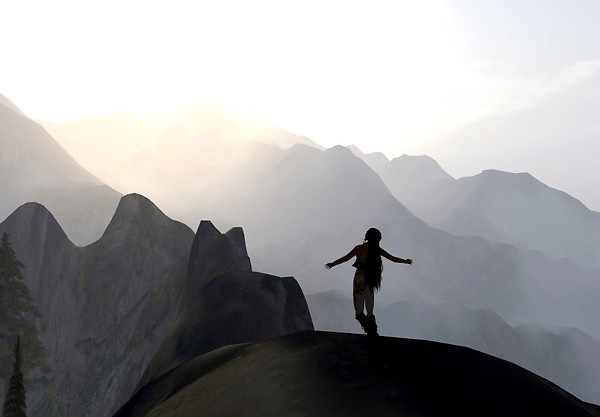
When we lift up our heads and look at our life on its vertical dimension, we will know that the Kingdom of God is nearer to us than we may initially think, and a sign of fresh hope is present and shining down on us from the heavens. When we look at life on its vertical dimensions, we are connected to the audacity to hope of African slaves who asked:
“Why should I feel discouraged, why should the shadows come, Why should my heart be lonely, and long for heav’n and home, When Jesus is my portion? My constant Friend is He: His eye is on the sparrow, and I know He watches me.”
In an ode to black women and black culture, the young prophet and sage Tupac Shakur, whose life was shaped by the making of music in a messed-up world, and whose music could powerfully speak into the lives of those living in a quiet hell, famously said:
“Some say the blacker the berry, the sweeter the juice; I say the darker the flesh, then the deeper the roots, I give a holla to my sisters on welfare, 2Pac cares if don’t nobody else care, And I know they like to beat you down a lot, When you come around the block, brothers clown a lot, But please don’t cry, dry your eyes, never let up. Forgive, but don’t forget, girl, keep ya head up.”
In these four words “keep ya head up” – which may not be good English, but sure is good theology – Tupac reminds us in the way only a prophet can that You gotta keep ya head up so that your heart and your spirit are not weighed down when our world begins to unravel.
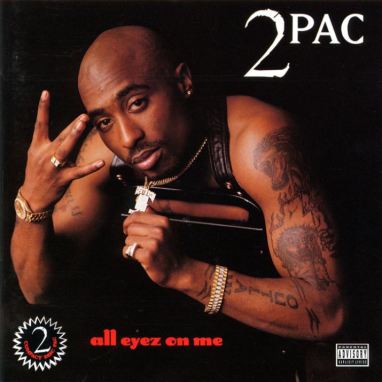
You gotta Keep Ya Head Up so that we may be alert and not miss the arrival of the Son of Man who is coming to bring salvation and deliverance for our lives.
You gotta Keep Ya’ Head Up and lift up our eyes to the [heavens] – from whence comes our help . . .” (Psalms 121).
You gotta Keep Ya’ Head Up as a testimony to the fact that regardless of how our life may seem to be unraveling we are going to continue to believe God anyhow, we are going to step out on faith anyhow, we are going to worship and give God praise anyhow, because we have the audacity to hope that someday the struggles of this life will all be done and “someday we’ll stand in the presence of the beautiful S[o]n” (The Five Stairsteps, “Ooh Child”).
Thus, as we wait for the return of the Son Man to this difficult word, just remember “even though you’re fed up, you got to keep ya head up!”
 My Thinking Deeper